 New York Architecture Boat Tour
The Spuyten Duyvil Bridge: Manhattan's 1900 Railroad Swing Bridge
The Spuyten Duyvil Bridge is the railroad swing bridge at the northern tip of Manhattan, and this page covers it and the Harlem River stretch of a Manhattan boat loop. The bridge was built in 1900, carries Amtrak trains and still opens for boats. You will find the bridge facts, the full list of Harlem River crossings, what happens to a full-loop cruise when the bridge cannot open, and what to see nearby, from the Henry Hudson Bridge to the Little Red Lighthouse. Only the full-loop cruises come this far north. The bookable tours are compared on New York architecture boat tours.
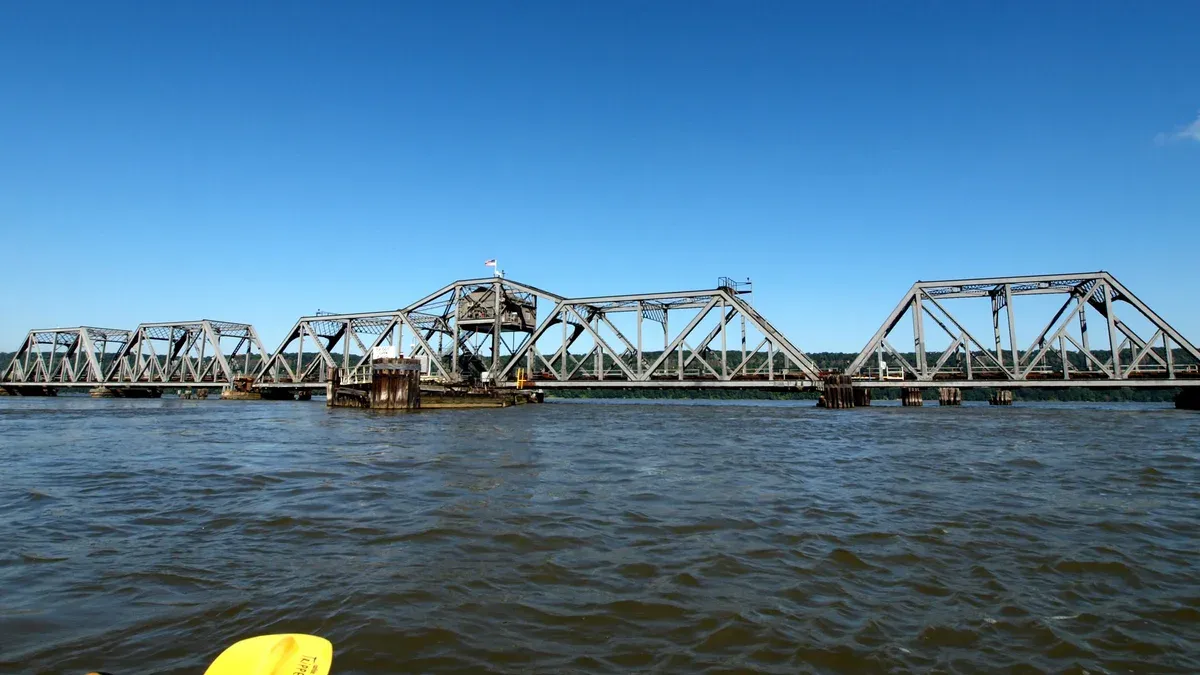
The Spuyten Duyvil swing bridge over the Harlem River in its closed position, seen from the water. Photo: Jag9889, CC BY-SA 4.0, via Wikimedia Commons
Quick answer The bridge in brief
The Spuyten Duyvil Bridge is a railroad swing bridge built in 1900, 610 feet long with a longest span of 286 feet, and Amtrak trains cross it on the Empire Connection. It opens over 1,000 times a year, mostly in summer for Circle Line and recreational boats.
Key takeaways
- The Circle Line Full Manhattan Boat Tour is the full-island loop that includes the Harlem River.
- The New York Architecture Yacht Cruise covers the Harlem River on a 2 hour 45 minute loop with AIA New York narration.
- See the bridge dates, spans and types in the Harlem River bridges table.
- What the listings say about a bridge that will not open is in the full-loop cruise section.
The Swing Bridge of 1900
The Spuyten Duyvil Bridge is the last crossing before the Hudson River meets the Harlem River at Manhattan's northern tip.
What It Is and What Crosses It
The Spuyten Duyvil Bridge is a railroad swing bridge built in 1900. Its total length is 610 feet and its longest span is 286 feet. The swing section is about 290 feet long and swivels nearly 65 degrees, leaving 100 feet of clearance on each side for boats to pass. Amtrak trains cross it on the Empire Connection. The bridge has a single track on its eastern side and about 30 trains cross it daily.
The swing span weighed 200 tons and its original steam motor was replaced by an electric motor in 1963. Amtrak service over the bridge resumed on April 7, 1991, and Amtrak repaired it in June 2018 using the world's largest floating crane.
How Often It Opens and Why
The bridge opens over 1,000 times a year. Most of those openings happen in summer, and most are for Circle Line boats and recreational craft. The bridge's opening schedule is not published for the public in the sources used here, so treat any claimed opening time as not stated.
The waterway it guards is not the original Spuyten Duyvil Creek channel either. The Harlem Ship Canal's Marble Hill cut opened on June 17, 1895, and in 1914 Marble Hill was joined to the Bronx with landfill that included rock from the Grand Central Terminal excavation. Three bridges now cross the former creek: the Spuyten Duyvil Bridge of 1900, the Henry Hudson Bridge of 1936 and the Broadway Bridge.
The Henry Hudson Bridge Next Door
Standing beside a swing bridge you also get a close look at the Henry Hudson Bridge, a double-deck steel arch that opened on December 12, 1936. David Steinman designed it, and at the time it was the longest plate girder arch and fixed arch bridge in the world. It is 2,208 feet long with an 841-foot longest span, and the upper deck was added on May 7, 1938. It carries six lanes of traffic with no commercial vehicles allowed.
The sources list the Henry Hudson Bridge with 143 feet of clearance below and 12 feet above the water at its low point. Boats on the Harlem River need less than 55 feet of air draft.
Sources: Spuyten Duyvil Bridge, Henry Hudson Bridge, Harlem River and Circle Line
The Harlem River Bridges
The Harlem River is an 8-mile tidal strait between Manhattan and the Bronx, and sources count its crossings differently, with one giving seven swing bridges, four lift bridges and four arch bridges and Wikipedia listing 13 from north to south. The table below takes each name and the opening years and bridge types given in the sources, and marks what is not stated rather than guessing.
The 13 Crossings Wikipedia Lists, North to South
The list reads from the Spuyten Duyvil Bridge at the Hudson River end down to the RFK Triborough at the East River end. High Bridge, built 1837 to 1848, is the oldest bridge in New York City. The Harlem Ship Canal was built in 1895.
Boats on the river need less than 55 feet of air draft. The river is also the traditional rowing course of New York and hosts Columbia, NYU, Fordham and Manhattan crews.
| Bridge | Opened | Type |
|---|---|---|
| Spuyten Duyvil Bridge | 1900 | Railroad swing bridge |
| Henry Hudson Bridge | December 12, 1936 | Double-deck steel arch |
| Broadway Bridge | 1960-62 (sources differ) | Double-deck vertical-lift, 558 feet long, 304-foot lift span |
| University Heights Bridge | not stated | not stated |
| Washington Bridge | not stated | not stated |
| Alexander Hamilton Bridge | not stated | not stated |
| High Bridge | May 30, 1848 | Stone arch aqueduct, 1,450 feet long, 140 feet above the river |
| Macombs Dam Bridge | not stated | not stated |
| 145th Street Bridge | not stated | not stated |
| Madison Avenue Bridge | not stated | not stated |
| Third Avenue Bridge | not stated | not stated |
| Willis Avenue Bridge | not stated | not stated |
| RFK Triborough Bridge | not stated | not stated |
High Bridge, the Oldest of Them All
High Bridge deserves a second look from the water. John B. Jervis and James Renwick Jr. designed it with 15 stone arches, and it opened on May 30, 1848. Five mid-river arches were replaced by one 450-foot steel arch in 1928 to improve navigation.
After a $62 million restoration it reopened to pedestrians and bicycles on June 9, 2015. The river's rowing tradition and the drawbridges make this stretch feel completely different from the harbor. For the full downtown skyline picture, see the Manhattan skyline guide, which covers the towers that frame the southern half of the loop.
When the Bridge Decides Your Cruise
Only the full-loop cruises reach the Spuyten Duyvil Bridge at all. Here is what their listings say, what they cost here, and what happens when a moveable bridge refuses to move.
The Cruises That Go This Way
The full-loop cruises in the comparison aim for the northern stretch. The Manhattan Architecture Yacht Cruise is a 2 hour 45 minute loop of Manhattan on a 1920s-style yacht for $85.50 per person, passing under the bridges of the Hudson, East and Harlem Rivers with narration by a member of the AIA New York Chapter. The Circle Line Full Manhattan Boat Tour is Circle Line's Best of NYC cruise, 2.5 hours for $39 per person. Circle Line's own page says it circles all of Manhattan, passes three rivers and all five boroughs and sails under 20 bridges. Circle Line's own route map highlights 14 landmarks including Yankee Stadium and the George Washington Bridge. The other cruises in the comparison, from the 80-Minute NYC Skyline Cruise at $29.75 to the sunset sailings, turn back long before the Harlem River.
The AIANY listing says the full circuit of Manhattan is not guaranteed. If the Spuyten Duyvil train bridge cannot open, the operator doubles back along the route with more waterfront detail, and there is no refund for that. The AIANY Climate Change cruise carries the same warning. The Circle Line listing says that on rare occasions during exceptionally high tides the boat cannot fully circle Manhattan and the route is adjusted.
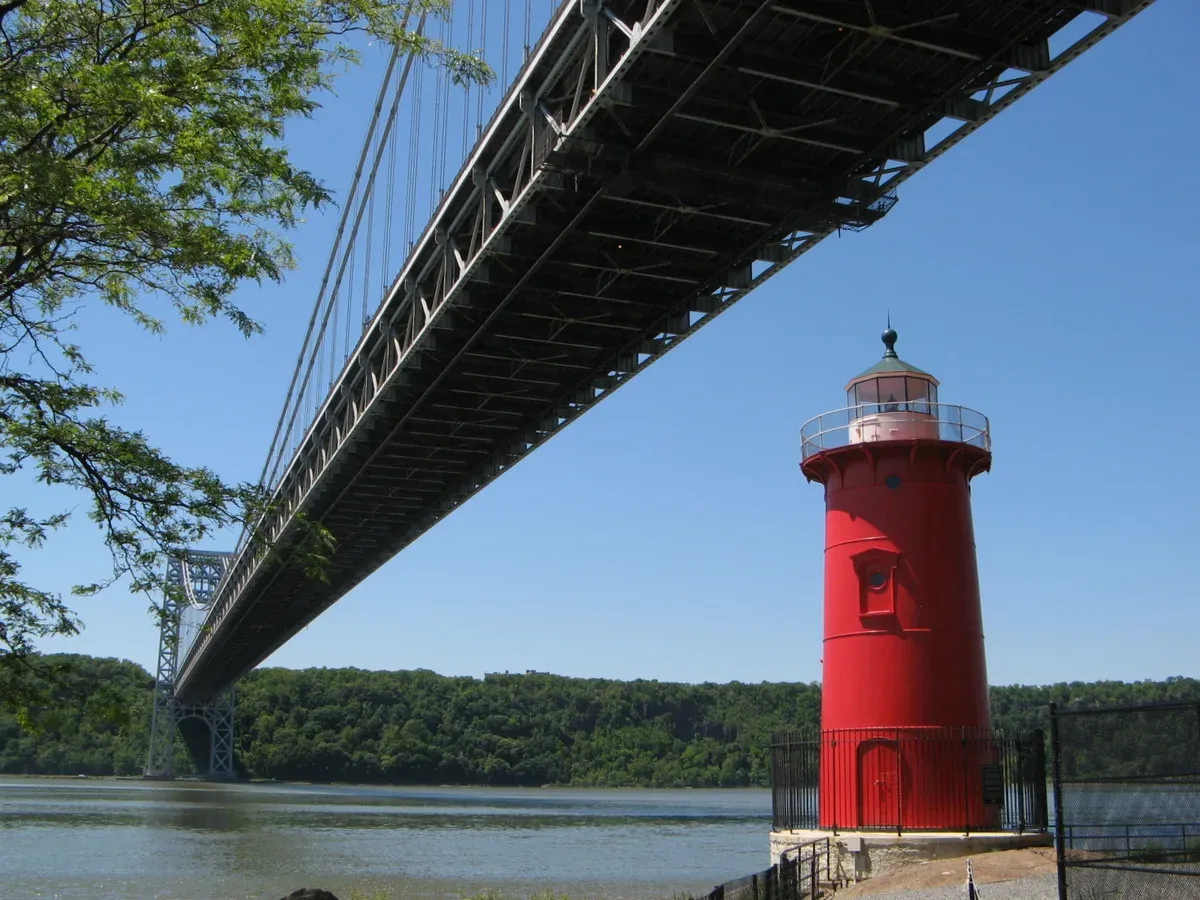
The Little Red Lighthouse standing below the George Washington Bridge on the Hudson. Photo: olekinderhook, CC BY 3.0, via Wikimedia Commons
Inwood, the Cloisters and the Little Red Lighthouse
The northern tip of Manhattan holds the landmarks where the Hudson side of a loop meets the Harlem River.
The Little Red Lighthouse Under the Great Gray Bridge
The Little Red Lighthouse is officially Jeffrey's Hook Light and stands 40 feet tall. It was built at Sandy Hook, New Jersey, moved to Fort Washington Park in 1921, and stands beneath the George Washington Bridge. The 1942 children's book The Little Red Lighthouse and the Great Gray Bridge helped save it from demolition in 1948.
The Coast Guard handed it to NYC Parks on July 23, 1951, it became an NYC landmark in 1991 and it was relit in 2002.
The George Washington Bridge from the Water
The George Washington Bridge opened on October 25, 1931 with a 3,500-foot main span and 14 lanes on two decks. Its towers are 604 feet tall, and it held the world's longest main span until the Golden Gate Bridge opened in 1937. Othmar Ammann was chief engineer and Cass Gilbert was consulting architect.
The Circle Line listing names it among the landmarks passed.
Inwood Hill Park and The Cloisters
Inwood Hill Park covers 196.4 acres and holds the last old-growth forest on Manhattan, so the shoreline here is trees rather than towers. A short way south, Fort Tryon Park holds The Cloisters, which opened on May 10, 1938 on a 66.5-acre site. John D. Rockefeller Jr. donated the site to the Met in 1931, Charles Collens designed the building, and the museum holds about 5,000 works of medieval European art including the c. 1495 Unicorn Tapestries.
The Circle Line listing names The Cloisters among its landmarks. The Harlem River Speedway began as a horse racetrack in 1898 and later became the Harlem River Drive.
Inside the Swing Span
The Spuyten Duyvil Bridge is one of the few moving bridges in New York City that you can watch turn in real time from the water.
Trains and Repairs
A single track sits on the eastern side and around 30 trains cross every day, most of them Amtrak trains on the Empire Connection. Passenger service over the bridge resumed on April 7, 1991, after decades without regular use. In June 2018 Amtrak repaired the bridge with the world's largest floating crane, brought up the Hudson for the job.
Passengers on the full-loop New York Architecture Yacht Cruise at $85.50 ride right past it, since the 2.75-hour route covers the Harlem River and passes under the bridges along it.
Questions About the Spuyten Duyvil Bridge
What is the Spuyten Duyvil Bridge?
It is a railroad swing bridge built in 1900, 610 feet long with a longest span of 286 feet, carrying Amtrak trains on the Empire Connection. The full details are in the section on the swing bridge of 1900.
How often does the Spuyten Duyvil Bridge open?
It opens over 1,000 times a year, mostly in summer for Circle Line and recreational boats. A published opening schedule is not stated in the sources. You can see which cruises pass it in the section on when the bridge decides your cruise.
Can you walk across the Spuyten Duyvil Bridge?
The sources describe no pedestrian access. It is a single-track railroad bridge with about 30 trains crossing daily. For walking, High Bridge is the pedestrian crossing on the Harlem River, reopened in 2015 after a $62 million restoration, covered in the Harlem River bridges table.
Do any boat tours pass the Spuyten Duyvil Bridge?
The full-island loops do. The Circle Line Full Manhattan Boat Tour runs 2.5 hours for $39 per person, and Circle Line's own page says it circles all of Manhattan and sails under 20 bridges. The AIA-narrated yacht loop also covers the Harlem River.
Why is it called Spuyten Duyvil?
The name belongs to the neighborhood and the former creek at Manhattan's northern tip, and the sources used here do not give an etymology, so the meaning is not stated on this page. The three crossings of the old creek, including the 1900 bridge and the Henry Hudson Bridge, are described in the swing bridge of 1900.
What will I see near the bridge on a cruise?
The 40-foot Little Red Lighthouse beneath the 604-foot towers of the George Washington Bridge, plus the wooded shore of Inwood Hill Park. Both landmarks are covered in the section on Inwood, the Cloisters and the Little Red Lighthouse.